HoverTap offerings to see sacred energy in motion
What is Bhairava?
Bhairava is the fierce manifestation of Lord Shiva, the supreme consciousness governing time, space, and dissolution. The Sanskrit word "Bhairava" derives from the root bhī (to frighten), meaning "the terrible, awe-inspiring one." In Tantric tradition, the name is also symbolically interpreted through three syllables: Bha (Bharana, sustenance), Ra (Ravana, dissolution), and Va (Vamana, manifestation/creation), representing the cosmic trinity of sthiti, samhara, and srishti.
Origins in the Shiva Purana
According to the Shiva Purana (Satarudra Samhita), Bhairava emerged when Shiva severed the fifth head of Brahma, an act symbolizing the cutting of ego and false pride. Brahma falsely claimed to have seen the top of the cosmic pillar of light. Shiva then manifested Bhairava from the region between his brows to punish this dishonesty. This was not an act of violence, but a cosmic lesson: even the Creator himself is subject to the laws of dharma.
Bhairava carried Brahma's skull as a begging bowl (kapala) as penance, wandering the earth until he reached Varanasi (Kashi), where the skull fell from his hand. This is why Bhairava is known as the eternal guardian (Kotwal) of Kashi. Pride dissolves in the presence of ultimate truth.
The Sacred Iconography
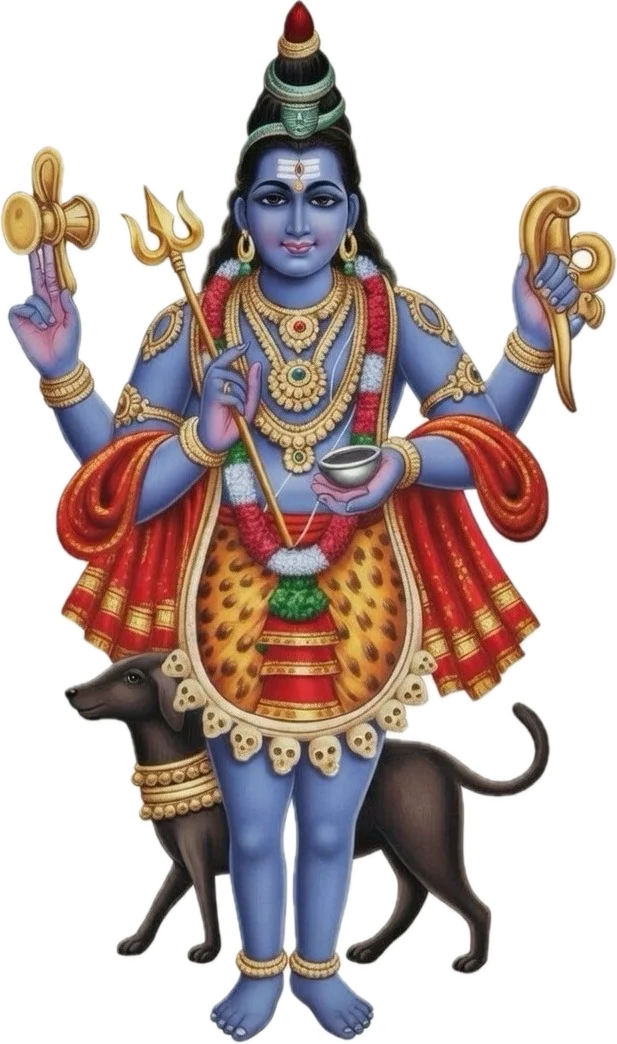
The fierce form of Bhairava adorned with skull garlands, smeared with cremation ash, accompanied by a loyal dog, holding a trident and damaru carries profound meaning:
- Skull garlands (mundamala): Each skull represents a dissolved cycle of birth and death, a conquered attachment
- Cremation ash (vibhuti): Reminder that all material forms return to ash; only consciousness remains
- Dog companion (shvana): Symbol of unwavering loyalty, protection of dharma, and discrimination between truth and illusion
- Nakedness (digambara): Freedom from the coverings of maya, complete transparency before the cosmos
- Trident (trishula): Control over the three gunas (sattva, rajas, tamas) and three times (past, present, future)
"वाराणस्यां भैरवो देवः संसारभयनाशनः।
अनेकजन्मकृतं पापं दर्शनेन विनश्यति॥"
"In Varanasi resides Bhairava Deva, the destroyer of worldly fear. The sins accumulated over countless births are destroyed by His darshan."
Traditional verse on Kala Bhairava (Kashi Mahatmya)How to Approach Bhairava?
Unlike many deities who accept elaborate rituals from a distance, Bhairava demands direct engagement. He is not interested in your performance. He reads your sincerity, your willingness to transform, and your capacity to face truth without flinching.
The Significance of Pooja (Worship)
Pooja to Bhairava is not just ritual. It is conscious realignment. When you offer flowers, you're not decorating an idol; you're symbolically offering the blooming of your own consciousness. When you pour water in abhishekam, you're washing away layers of conditioning. Each element has purpose:
- Pushpa (Flowers): Offering the beauty of your intentions, the fragrance of devotion
- Abhishek (Water/Milk): Purification of the mind, cooling the heat of desires
- Aarti (Fire): Illumination of inner darkness, burning of ignorance
- Dhoop (Incense): Elevation of consciousness, ascending beyond the material
- Naivedya (Food Offering): Surrender of the fruits of your actions, acknowledging the divine as the ultimate enjoyer
The Power of Naam Japa
Japa is the foundation of Bhairava sadhana. The continuous repetition of Bhairava's names and mantras creates a vibrational resonance that gradually attunes your consciousness to his frequency. Traditional texts prescribe counts of 108, 1008, 10,000, or even a lakh (100,000) repetitions, not to burden you, but to create sustained immersion.
Start small but start sincerely. Five minutes of genuine japa with full attention is infinitely more powerful than an hour of mechanical repetition. Bhairava responds to intensity, not quantity.
Core Forms of Bhairava
Three primary gateways for practitioners at different stages plus the complete spectrum of 64 manifestations
Batuk Bhairav
The Youthful Protector. Batuk is Bhairava in his child form: innocent yet powerful, playful yet fierce. Ideal starting point for beginners.
- Removes obstacles to learning and growth
- Protects from negative influences and fear
- Guides students and young seekers
- Gentle introduction to fierce consciousness
Swarnakarshan Bhairav
The Prosperity Guide. Swarnakarshan (literally "one who attracts gold") governs material abundance with spiritual alignment.
- Attracts wealth and material resources
- Removes financial obstacles and debts
- Ensures prosperity serves spiritual growth
- Ideal for householders balancing both worlds
Kal Bhairav
The Time Regulator. Kala (Time) Bhairava is the ultimate form: the master of time itself, the guardian of cosmic order.
- Transcends the limitations of time
- Dissolves deep karmic patterns
- For advanced practitioners (3+ years experience)
- Direct path to liberation (moksha)
The 64 Manifestations: Complete Cosmic Coverage
Beyond these three core forms, Bhairava manifests in 64 distinct expressions (8 primary Ashta Bhairavas, each presiding over 8 subordinate forms) representing the complete spectrum of consciousness across all directions, dimensions, and states of being.
Bhairava and Shakti: The Tantric Union
In Tantric philosophy, Bhairava is not complete without Shakti, and Shakti cannot manifest without Bhairava. They are the inseparable duality within non-duality. Shiva is pure consciousness (Chit), Shakti is dynamic energy (Kriya).
The Vijñāna Bhairava Tantra
The Vijñāna Bhairava Tantra, one of the most revered texts in Kashmir Shaivism, is structured as a dialogue between Bhairava and Devi (Shakti). She asks: "What is the true nature of reality?" And he responds not with theology, but with 112 meditation techniques (dharanas) for direct realization.
Shiva without Shakti = Pure potential with no manifestation (shava, meaning corpse)
Shakti without Shiva = Chaotic energy with no direction
"शिवः शक्त्या युक्तो यदि भवति शक्तः प्रभवितुम्।
न चेदेवं देवो न खलु कुशलः स्पन्दितुमपि॥"
"Shiva, united with Shakti, becomes capable of creation. Without her, even the divine cannot so much as stir."
Saundaryalahari, Verse 1Bhairava Tattva: Core Philosophical Principles
18 progressive articles exploring Bhairava consciousness from foundational concepts to advanced tantric realizations
Protection Tattva
How Bhairava's fierce presence creates an impenetrable shield by dissolving the concept of "enemy."
Read Full Article →Fearlessness Tattva
True fearlessness is not the absence of fear. It is the complete dissolution of the one who fears.
Read Full Article →Ego Dissolution Tattva
The skull garland is not decoration. It is a map. Each skull represents a layer of identity that must be severed.
Read Full Article →Life Reversal Tattva
When everything collapses, career, relationships, identity, Bhairava is orchestrating a complete reset.
Read Full Article →Ultimate Absorption Tattva
The final stage: when the seeker, the path, and the goal collapse into a single point of pure consciousness.
Read Full Article →Moksha Tattva
Liberation is not an achievement. It is the recognition that you were never bound.
Read Full Article →Where Would You Like to Begin?
Whether you are new to Bhairava or deep in practice, there is a path for you
Explore the Sacred Path
Each section is a gateway to deeper understanding of Bhairava
64 Forms
Complete spectrum of consciousness frequencies
Tree of Bhairavas
All 64 forms as a living tree
Sacred Stotras
Hymns with Sanskrit & deep meaning
Puja Vidhi
Detailed worship procedures
Naam Japa
Digital mala counter for practice
Bhairava Tattva
Philosophical principles
Life Purpose
Personalized sadhana recommendations
Sadhana
11, 40, 90 & 108 day programs
Articles & Stories
Deep philosophy & scriptural wisdom